
Bring in the Cleaner
Nikita, Wick and Worldbuilding

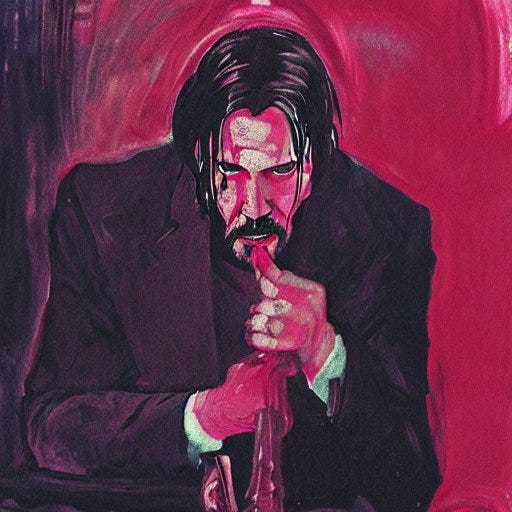
Before Wick, there was Nikita. A stylish film about a reluctant but preternaturally skilled killer describes John Wick and 1990’s Nikita. Luc Besson’s art-house action film preceded Wick in disguising a world of assassins in plain sight and worldbuilding through sleight of hand. One story beat in both Wick and Nikita is the employment of mysterious ‘cleaners.’ The secretive profession establish a deeply stratified ecosystem of trades to keep the killing and illicit business from being discovered.
In the first third of John Wick, after being dragged back into the killing trade, Wick plays with a stack of gold coins while making a telephone ‘reservation.’ The puzzling call leads to a knock at Wick’s door, which reveals a van outside with the name “Specialized Waste Disposal” stenciled on its side. It is transporting a group of tradesmen with a single duty- cleaning the killing fields.
In a series of edits, these quiet burly men wander Wick’s home, now littered with a dead hit team, and wash the scene of evidence. Even as brief as the part was, it is the second indication that there is an undercurrent of specialized trades working alongside the assassin class. The gold coins are not normal lucre but payment and recognition of their membership in the clandestine world. Something like a cleaner character may seem mundane, but its effectiveness in worldbuilding is essential. Using a cleaner in the assassin genre is not without film precedent, as Luc Besson introduced the world to the enigmatic profession of ‘cleaner’ in Nikita.
Starring Anne Parillaud and Tcheky Karyo, Nikita transported the viewer to an off-kilter France in the early 1990s. The eponymous Nikita (Parillaud) and her crew of nihilistic punks wander Paris’s streets in a drug-addled haze. One pharmacy break-in too many leads to the death of a responding Gendarme, the killing of Nikita’s companions, and her death sentence. Execution, however, is not the final stop as Nikita becomes an agent of the mysterious French intelligence agency, the Centre, led by the charismatic and brutal leader, Bob (Karyo.) A reluctant recruit, the harshly trained Nikita learns martial arts, weapons, spy craft, and the classic ideals of French femininity. Throughout the film, Nikita is tasked with ever more complex or dangerous tasks by Centre, including an iconic restaurant gunfight, before her final mission takes a bad turn. To pick up the pieces and finish the assignment, Centre brings in Victor, the cleaner.
Perhaps one of the stylish character introductions in film history, Victor arrives at the debacle as a silhouette accompanied by a rhythmic bass lick. Snapping a guard’s neck and gunning down another from the rising elevator cage, Victor emerges as a sunglass-wearing specter. Inscrutable and quiet, Victor (Jean Reno) carries a plain-looking leather pilot’s case concealing jugs of acid. Nikita dreads Victor’s appearance because he has legend and license on his side- he will dispose of the bodies with a bath of acid and do the same to Nikita to complete the mission.
In Wick and Nikita, the addition of secondary criminal professions adds a fresh layer of interest to the otherwise ‘paint by numbers’ genre framework. Wick’s use of the cleaner idea is more restrained than Nikita’s. The crew’s only other appearance is late in the first film after rogue assassin Perkins (Adrianne Palicki) has her Continental privileges ‘revoked.’ Rather than portraying the cleaner as a low or servile position, the characters in Wick and Nikita are indispensable.
Hierarchy plays an important role in Wick, with the as-yet-unseen High Table members or the Continental’s owner-manager Winston Scott occupying the highest rungs on the ladder. Beneath them are other functionaries that appear in Wick’s chapters two, three, and four. Yet in the Wick universe, there is a common thread of respect and even decency in the darkest professions.
Admittedly not a prestige job in the filmic sense, Wick’s cleaners embody Hamilton, Redman, and McMurray’s observation that real-world waste collectors stood apart “from those who would not or could not do their work.” [1] Handling the dead or cleaning a scene of remains also maintains a taboo or dismissal to classes above. Traditionally, the disposition of human remains is done with solemnity and respect; violations of those long-established behaviors are harshly judged. However, handling the dead, even with detachment, also carries the stigma of low-class or unskilled work. The cleaner occupies a workman function within the Wick universe, but it is never dismissed as low. The cleaners brought in by Wick move as professionals with “different role, skill and status attributes that served to increase and assert the dignity of individual workers.” [2]
The cleaners in Wick are carried through the plot with the same sense of dignity, even if the occupation deals with the dead and viscera. Morbid as it may be to the viewer, the professionalism and systematic nature of the cleaners ensure the world continues to operate without pause. Taken for granted or ignoring the performance of Wick’s cleaners diminishes the worldbuilding potential of their role. By carrying out their duties with detachment, the cleaners behave with an intensity suggesting in-universe prestige.
The cleaners suggest a complex ecosystem unshown in the first film. If there are dedicated cleaners, the viewer wonders what other roles exist in the cinematic universe.
Next, in the Worldbuilding John Wick series, we’ll examine the now iconic world of The Continental Hotel.
[1] Hamilton, P., Redman, T. & McMurray, R. ‘Lower than a Snake’s Belly’: Discursive Constructions of Dignity and Heroism in Low-Status Garbage Work. J Bus Ethics 156, 889–901 (2019). https://doi.org/10.1007/s10551-017-3618-z
[2] ibid.